Week 6 of 2026 Session

Week 6 of 2026 Session My sincerest appreciation to everyone who attended District 1 night in Annapolis making it a huge success. Thank you all for your support! Senator Mike McKay […]

Week 6 of 2026 Session

Week 6 of 2026 Session My sincerest appreciation to everyone who attended District 1 night in Annapolis making it a huge success. Thank you all for your support! Senator Mike McKay […]

Week 6 of 2026 Session
My sincerest appreciation to everyone who attended District 1 night in Annapolis making it a huge success. Thank you all for your support!
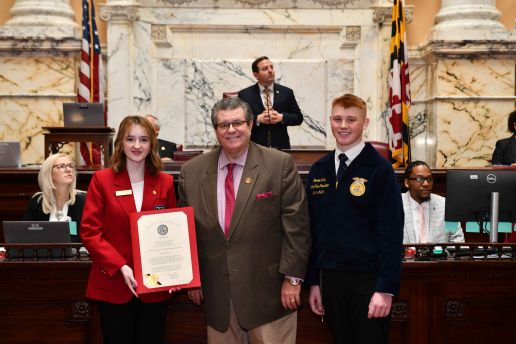
Senator Mike McKay proudly welcomes the Maryland Career & Technical Student Organization (CTSO) State Officers to Annapolis on Wednesday, February 18th, as we celebrate National CTSO Week and recognize February as Career & Technical Education (CTE) Month.

We are honored to host outstanding student leaders from FFA, FBLA, Educators Rising, and SkillsUSA — organizations that prepare students for success in the workforce and develop the next generation of skilled professionals.

These students represent the very best of Maryland’s talent, leadership, and commitment to excellence. Welcome to your State House — your future is bright, and your state is proud of you.

— Senator Mike McKay

BILL SPOTLIGHT
SB 26 – Off-Grid Electricity Providers – Exemption
Press Conference
My Name is Senator Mike McKay and I am proud to share with you SB 26, a bill focused on accelerating energy availability through a new framework known as Consumer Regulated Electricity (CRE). The proposal comes from a growing concerns about rising electricity costs, grid reliability, and the inability of traditional utility systems to keep pace with rapidly increasing demand.

Maryland residents statewide, especially in Appalachia where I represent have the following upsets:

Electricity bills are becoming increasingly unaffordable. Grid operators report that large new industrial and commercial loads are already straining reliability as well as the lack of public support for more transmission lines.It should be noted that Federal energy officials have stated that current approaches cannot meet projected load growth fast enough.

SB 26 positions CRE as a solution designed to enable independent, off‑grid, large‑scale electricity providers to serve new non‑residential customers. These CRE utilities would operate outside the existing grid and outside traditional utility regulation, allowing for faster development and greater innovation.

It is important to articulate.

No risk to existing ratepayers, since CRE systems are off‑grid and serve only new commercial or industrial loadNo impact on residential consumers, who remain fully served by existing utilitiesReduced pressure on utilities, the Public Service Commission, and PJM, allowing them to focus on affordability and reliability for current customersEconomic development benefits, as CRE can attract new businesses requiring large, reliable power suppliesOpportunities for innovation, creating a testbed for modern utility models and technologies

I would like to note that a complementary federal bill has already been introduced to exempt CRE utilities from certain federal regulations, signaling growing national interest in this model.

With SB 26, passage will affirm that meeting tomorrow’s energy demand requires bold, innovative solutions that protect ratepayers while enabling responsible growth.

Senator Mike McKay
Allegany, Garrett and Washington Counties Serving Appalachia Maryland

Read More Here – ‘McKay’s Energy Bill Gets Hearing Before Senate’
‘Senate Bill 26 – Public Utilities – Off-Grid Electricity Providers – Exemption’ One of Seven Bills included in Senate Republicans Preview 2026 Energy Package to Deliver Real Rate Relief and Restore Grid Reliability

February 20, 2026 –  Press Release from Maryland Senate Republican Caucus

Annapolis, Md. — With Maryland families facing sustained high electricity costs, growing grid reliability concerns, and increasing pressure on agricultural and preservation lands, Senate Republicans today previewed their 2026 Energy Package — a coordinated legislative effort that will lower rates, strengthen long-term energy planning, protect farmland, and correct policies that have contributed to Maryland’s current energy crisis.

Several of the bills in the package will be heard today in the Senate Education, Energy, and the Environment Committee.

“Addressing rising energy costs has been an all-hands-on-deck effort for our caucus,”
said Senate Minority Leader Steve Hershey. “A majority of our members have stepped
forward with serious, substantive legislation that tackles the root causes of Maryland’s
energy challenges. This package reflects months of work to deliver structural reform and permanent relief for Maryland ratepayers.”

Senate Minority Whip Justin Ready added, “Mailing out a one-time $40 rebate —
essentially giving Marylanders back a small portion of what they were overcharged — is
not progress. Real relief means lowering the monthly bill, not issuing a refund after the
damage is done. Families don’t want temporary credits they want lower monthly bills.
That means fixing the policies that are driving up costs in the first place.”

A Coordinated Energy Reset
Together, these bills increase transparency and strategic planning, reduce compliance-driven cost layering, moderate monthly surcharge impacts, protect residential ratepayers, strengthen grid reliability and support responsible economic growth.

Additional legislation may be incorporated into the Senate Republican Energy Package as the 2026 session progresses, as caucus members continue advancing reforms focused on affordability, accountability, and reliability.

“Marylanders deserve structural reform — not short-term patches,” Hershey said. “This package represents serious work and real solutions to bring stability and relief to our state’s energy landscape.”
——————————–
Senate Bill 26 – Public Utilities – Off-Grid Electricity Providers – Exemption
Sponsor: Senator Mike McKay

Maryland is experiencing rapid growth in high-demand commercial load, including data centers and advanced manufacturing facilities. SB 26 provides a forward-looking solution allowing Maryland to meet growing demand while protecting the affordability and reliability of the existing system and
• Establishes a Consumer Regulated Electricity (CRE) framework for large-scale, independent, off-grid power providers.
• Enables new industrial and commercial customers to secure dedicated electricity supply outside the regulated grid.
• Protects existing residential ratepayers from cost or reliability impacts.
• Reduces strain on the regulated grid and the PJM Interconnection market.
• Supports economic development without shifting infrastructure costs onto current customers.

“Marylanders shouldn’t have to pay higher bills because large new facilities are pulling more power from an already strained grid,” said Senator Mike McKay. “SB 26 lets new high-demand users — like data centers — develop their own dedicated energy supply so existing families and small businesses aren’t stuck footing the bill. It protects ratepayers while still allowing economic growth.”

Senator McKay’s Senate Bill 745 will be heard in the Judicial Proceedings Committee on 2/24/2026.  Click below to see the bill and the current status.

Police Training – Autism and Dementia (LEAD Act of 2026)

Summary:  This bill requires the Maryland Police Training and Standards Commission to require entrance-level and in-service police training to include certain training regarding individuals with dementia and autism.

“Without this proper training, misunderstandings can easily escalate unnecessarily,” McKay said during the press conference. “But with proper training, officers can recognize the signs, deescalate and more effectively respond in ways that are both protecting the individual and the officer.”  See more on my FACEBOOK page here.

Senator McKay’s Senate Bill 746 will be heard in the Judicial Proceedings Committee on 2/24/2026.  Click below to see the bill and the current status.

Police Discipline – Municipal Law Enforcement Agencies – Suspension Pending Appeal of Trial Board Decision

Summary:  This bill authorizes the chief of a law enforcement agency serving a municipality to suspend a police officer without pay during the pendency of a certain appeal; and providing that a police officer who was suspended without pay in accordance with the Act is entitled to receive certain back pay if the officer prevails on appeal.

Senator McKay’s Senate Bill 689 will be heard in the Judicial Proceedings Committee on 2/25/2026.  Click below to see the bill and the current status.

Task Force to Study Postrelease Services and Requirements (Bri’s Law)

Summary:  This bill established the Task Force to Study Postrelease Services and Requirements; and requiring the Task Force to report its findings and recommendations for improving postrelease programs designed to prevent recidivism to the Governor and General Assembly on or before July 1, 2027.

Senator McKay’s Senate Bill 800 will be heard in the Education, Energy, and the Environment Committee on 2/25/2026.  Click below to see the bill and the current status.

Task Force on the Implementation of Approval Voting and Ranked-Choice Voting

Summary:  This bill established the Task Force on the Implementation of Approval Voting and Ranked-Choice Voting; and requiring the Task Force to report its findings and recommendations to the Governor and the General Assembly by December 1, 2027.

McKay Delivers Major Investments for Garrett County

Senator Mike McKay secured millions in state funding for Garrett County projects—from water infrastructure and school improvements to fire department upgrades and community facilities.

“Garrett County families send plenty of tax dollars to Annapolis. My job is to fight like hell to bring some of that money back home,” said Senator McKay. “These aren’t handouts—this is Western Maryland’s money, invested right here where it belongs.”

  • Read the Full Article Here on his website.
Senator Mike McKay
Third Reader Floor Votes
This year I will post my votes from the floor to include every Third Reader vote given by me.  I include how I vote and the results of each bill.  My goal is to encourage all to participate in open and transparent government and be accountable to all by posting this on social medias as soon as possible.

A “third reader” vote is the final vote that is taken on a bill in the House. Each bill receives three readings on the floor in each chamber before it becomes law. The first reading is when the bill is introduced and referred to the appropriate committee. The second reading is when a bill comes back to the floor after being amended and passed out of its respective committee (not all bills get this far). This is also when the bill can be amended on the floor by all members of the chamber. The third reading for “final passage” is when the final version of the bill with all amendments is voted on before making its way to the Senate, or the Governor if the bill started out in the Senate.

CLICK HERE & SCROLL DOWN TO SEE ALL THIRD READER VOTES.